
Audit-ready ECL software for Ind AS 109 and IFRS 9
Replace spreadsheet-driven ECL runs with a governed workflow for data intake, segmentation, SICR/staging, PD-LGD-EAD models, scenarios, overlays, approvals, movement analysis, and disclosure-ready reporting.
Built for teams that need the allowance to be explainable, controlled, and review-ready.
Spreadsheet ECL versus governed ECL workflow
The strongest business case is not just faster calculation. It is a more controlled path from inputs and judgement to evidence, review, and disclosure.
Harder to control as complexity grows
Designed for repeatable review and evidence
Turn recurring ECL friction into a controlled operating workflow
The app is designed around the places where ECL processes usually break down: data readiness, scenario governance, explainability, approvals, and reporting evidence.
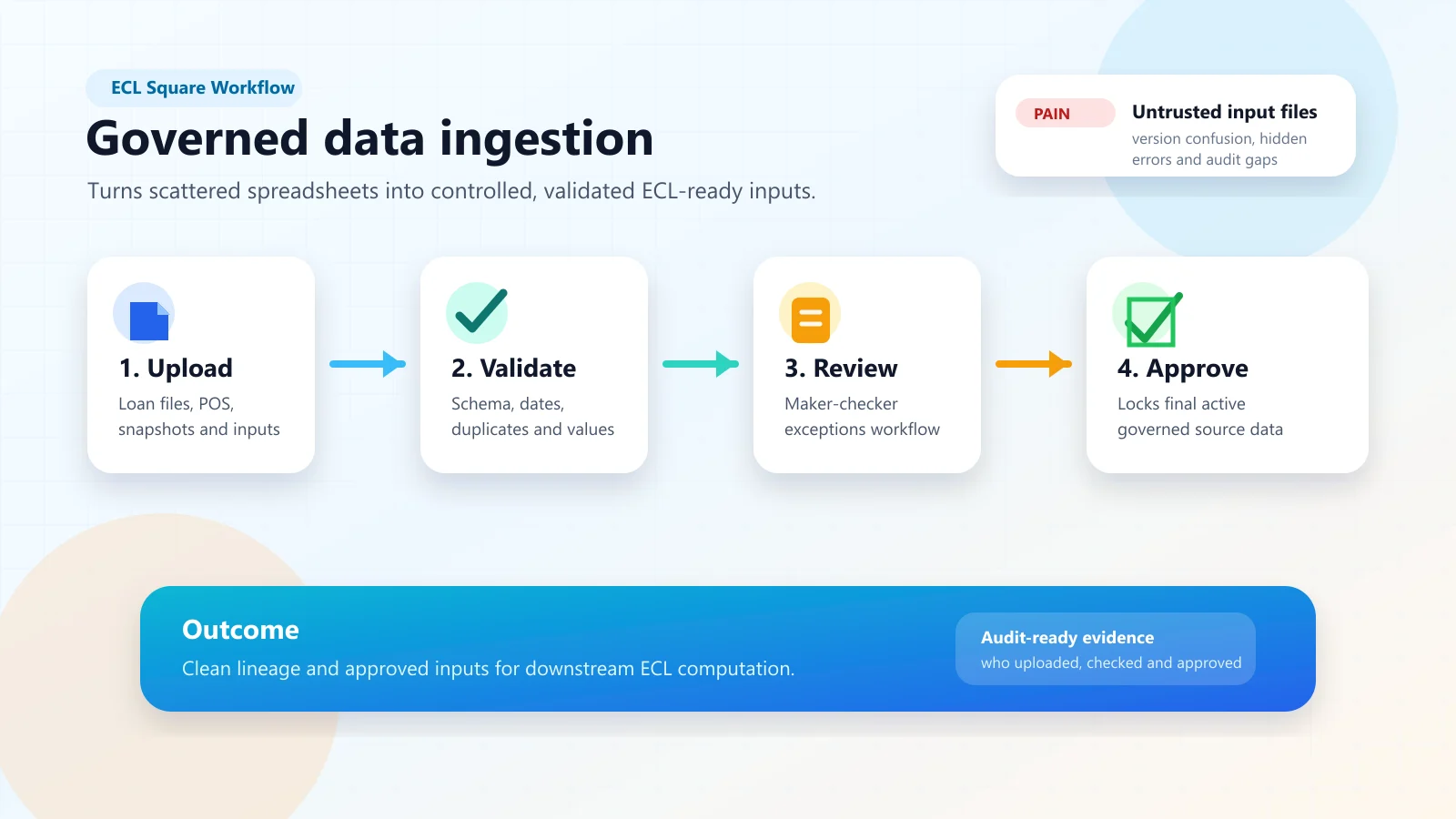
Governed data ingestion
Source files arrive in different formats, reconciliations sit outside the model, and late exceptions slow the close.
ECL Square brings ingestion, validation, exception review, and approved data snapshots into one controlled starting point.


ECL Programme Blueprint
Focus on the decisions that define a defensible allowance.
Expected Credit Loss becomes more explainable when scope, data, staging, modelling, overlays, disclosures, and governance are treated as one connected process rather than isolated workstreams.
Ind AS 109 ECL software for governed data-to-disclosure workflows.
Open the bottom-of-funnel page for teams comparing controlled ECL software and audit-ready reporting.
ECL software for NBFC staging, segmentation, overlays, and reporting.
Review how the platform workflow applies to lending portfolios, stage transfer governance, and committee evidence.
Compare spreadsheet ECL with a controlled ECL platform.
Use the comparison route when manual files, version control, and audit evidence are becoming the main constraint.
Control management overlays and post-model adjustments.
Connect overlay rationale, approval, expiry logic, movement impact, and disclosure evidence.
Audit-ready ECL reporting from approved outputs to evidence packs.
Review the route for movement analysis, stage summaries, committee packs, and disclosure-ready support.
Download ECL resources for governance, spreadsheet risk, and committee review.
Use the resource hub when the buyer needs a practical checklist or scorecard before a discussion.
Start with the programme blueprint, then move through the pillar articles that build the full ECL operating model.
The series begins with blueprint design and expands through scoping, segmentation, staging, modelling, overlays, controls, and disclosure support with clear evidence at each step.
ECL Programme Blueprint
Set ECL scope, ownership, measurement routes, review cadence, and evidence expectations before model complexity or audit scrutiny takes over.

Data Architecture, Integrity and Segmentation
Create the data foundation for ECL through source mapping, segmentation logic, reconciliations, exceptions, and readiness checks that reviewers can trust.

SICR Framework and Stage Transfer Governance
Establish significant increase in credit risk through quantitative and qualitative indicators, backstops, cure logic, and review workflow that management can defend.

PD, LGD and EAD Modelling Framework
Translate policy into PD, LGD, EAD, term structure logic, calibration discipline, and portfolio-fit evidence that reviewers can challenge.
Go deeper into key ECL questions without losing the thread of the wider framework.
Move from core methodology into specialist issues such as measurement choice, stage discipline, overlays, evidence, and reviewer challenge.

ECL Programme Blueprint
Define ECL scope, ownership, evidence, and review cadence before models, spreadsheets, or audit questions expose operating gaps.
Portfolio Scoping and Segmentation
Designing the portfolio architecture that makes Expected Credit Loss meaningful, credible and decision-useful.
Data Architecture, Integrity and Readiness
Build source mapping, reconciliations, exceptions, and data controls that make ECL outputs reviewable by finance, risk, and auditors.

Defining Default, Cure and Credit-Impaired Status
Set default, cure, and credit-impaired rules that align risk evidence, staging logic, model calibration, and reviewer challenge.
























How ECL Square moves a close cycle from source data to disclosure evidence.
The homepage product story follows the full operating path a finance, risk, and audit team needs to control before the allowance can be defended.
Data intake
Validation
Segmentation
SICR and staging
PD-LGD-EAD models
Macro scenarios
Management overlays
Approvals
Movement analysis
Disclosure-ready reporting
Concrete workflow evidence, not only methodology claims.
The product story pairs each claim with screenshots, visual workflow assets, output pack previews, or anonymized implementation proof.

Mid-sized NBFC: from close-cycle reconstruction to controlled evidence.
- Stage movement and overlays maintained across separate workbooks.
- Review comments and approvals scattered across email trails.
- Committee pack rebuilt manually after final ECL numbers were agreed.
- Approved inputs, stage logic, overlays, and reviewer notes captured in one workflow.
- Movement analysis and evidence pack generated from controlled outputs.
- Finance, risk, and audit worked from the same review trail.
Take the right ECL issue into a focused implementation conversation.
Some teams start with programme blueprint and governance. Others come in through data readiness, SICR, scenarios, overlays, disclosures, or platform control. The objective is the same: move quickly to the part of ECL that needs clearer judgement or stronger execution.